

Welcome to Express Post Services, your trusted partner for reliable and efficient courier services in collaboration with DHL. At Express Post Services, we strive to provide top-notch shipping solutions to meet all your needs, whether you’re a small business or a large enterprise.
This content was extracted from DHL’s official website, ensuring you receive accurate and up-to-date information.
Japan is a highly developed country with significant purchasing power, a digitally mature population, and strong credit card and smartphone penetration. Japan’s trade regulations are easy to navigate, and its tax laws are relatively straightforward.

Slightly below the global average, but Japan’s e-commerce growth (CAGR 2023-2027) is very strong for a developed nation. Compare this to the UK’s 7% growth.1
Market overview
E-commerce in Japan is still growing. User penetration (the number of adult consumers who regularly use e-commerce) will be 78.5% by the end of 2023 and is expected to hit 92.8% by 2027. This is impressive growth in the context of Japan’s economic place in the world: it is the third largest economy after the USA and China.2
Japan has been relatively slow to adopt online shopping, but it is growing fast. Every year e-commerce takes around 0.5% of the share of total retail as the popularity of online shopping expands. Fast delivery is large part of the rising growth in e-commerce. Speed and convenience are vital.3

Consumer trends
Sharing, renting, reusing and refurbished items show gains
While Japanese consumers strongly valued ownership not long ago, consumers are quickly becoming more open to sharing or renting items rather than purchasing. Items include books, bicycles, electric cars, and even clothing.
Equally, the stigma associated with buying used goods has largely lifted, especially as consumers increasingly value sustainability over ‘brand new’.
Subscription services
Brands are using subscriptions for a range of products, from new cars to skincare and beauty products. The subscription economy gained popularity during the Covid-19 pandemic.
Japan e-commerce: Most common cross-border importers
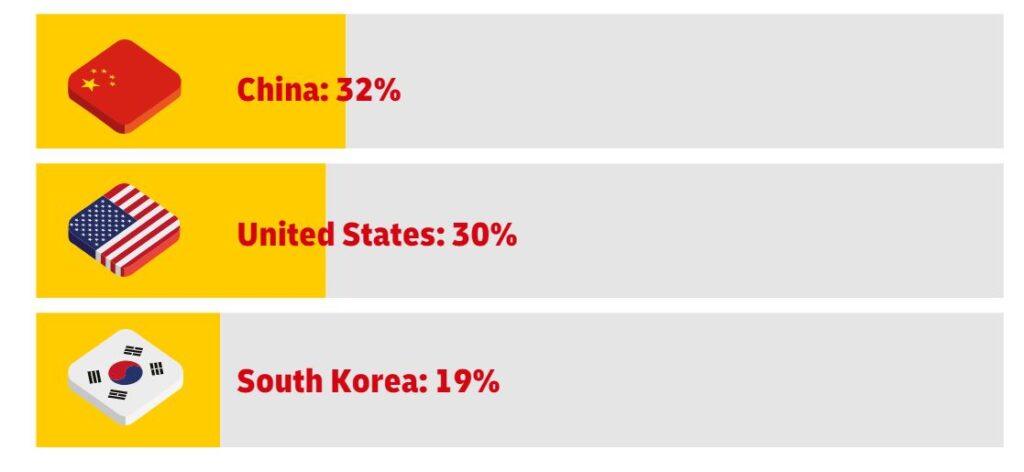

Top trading partners importing to Japan in 2022.4
What do Japanese shoppers buy online?
Unlike other countries, e-commerce in Japan is not entirely dominated by fashion and clothing. Food, electrical goods, and interior décor goods are just as important.
Here are the biggest B2C e-commerce market sectors in Japan as of 2021 (in billions of Japanese yen)5:

Where do shoppers in Japan buy online?
The top five most popular online marketplaces in Japan6

Annual visitors, Dec 2022
Japan’s most popular payment options
Credit cards are the most popular payment method for online purchases among digital buyers in Japan.7

Another unique payment method in Japan is paying at convenience stores (known as Konbini), which accounts for about a third of payments and is available at 55,000 locations nationwide. This method is especially popular among teenagers without bank accounts or access to credit.
Cash on delivery is also relatively common, with around 20% of online buyers using this method due to its perceived security and anonymity when making online purchases.
Holidays and events to look out for
Like many countries, Japan has a unique number of national holidays and events that e-commerce providers should look out for.
- Gift purchases rise during Valentine’s Day, White Day, and Christmas Day
- Many Japanese take a vacation during Shogatsu (New Year Holiday period: December 28 – January 3) and Obon holiday (5 days in mid-August) and tend to be absent from home.
- Hatsu-Uri (New Year Sale) takes place in early January.
- Winter Clearance Sale occurs in February, mainly for fashion items

- Shin Sei Katsu sale (Back to School & New Life Sales) runs from March to early April (recently starting from mid-February).
- Golden Week Sale takes place from the end of April to early May.
- Black Friday in November is gradually spreading to Japan but is not as significant as in the US.
- Bonus Sale occurs in Summer/Winter (Seasonal bonuses are paid twice a year in Japan in early July and mid-December) in June-July and December.
Market entry strategy: Tips for e-commerce success in Japan
We asked DHL’s local Japan experts to help you overcome the most common challenges when exporting to this key market:
- Find a Japanese distributor. Finding a Japanese distributor can help you navigate the local market and make it easier for you to sell your products in Japan.
- Understand Japanese certification standards. Make sure you understand the certification standards that apply to your products in Japan. This will help ensure that your products meet the necessary requirements and can be sold in the Japanese market.
- Choose a reliable shipping provider to help you ship your products to Japan. Understand the import procedures and requirements for shipping products to Japan. Japanese address and zip codes must be accurately listed, as many towns and street names can sound similar.
- Offer fast, flexible delivery – and be smart about what you sell. Japanese consumers are now well accustomed to flexible delivery services offering adjustable delivery times, including one-day delivery. Houses and indoor living/working spaces in Japan do not have much space, so large household items or furniture sold by international brands tend not to be in high demand.
- Sell on Japanese e-commerce platforms. Consider selling your products on popular e-commerce platforms in Japan. This can help you reach a wider audience and increase your sales.

Business Practices in Japan: Import Regulations and Customs Clearance
Food products must be clearly labeled in Japanese at the point of sale to indicate their country of origin and any potential allergens. Food Sanitation Laws also apply to other products related to food or human consumption, such as kitchen utensils and cooking ware.

Electrical appliances and materials must meet technical standards and requirements, which affects their labeling and, consequently, their sale or exhibition.
To protect the environment, most businesses are required to recycle certain types of wrapping or packaging materials, including glass, paper, and plastics.
Plants and agricultural products are subject to quarantine requirements.
DHL offers further information through the DHL Trade Automation Service.
Taking your first steps into e-commerce in Japan?
Make sure you hit the ground running. Open a DHL Express Business Account for expert international shipping advice and competitive rates.
References
- Statista, accessed June 2023
- Statista, accessed June 2023
- Statista, 2021
- Statista, September 2022
- Statista, December 2022
- Statista, January 2023
- Statista, August 2022
This article was originally published on Discover, the small business and global logistics advice guide from DHL.