

03
Aug
2024
Rethinking Disaster Response: Humanitarian Logistics During A Pandemic
Welcome to Express Post Services, your trusted partner for reliable and efficient courier services in collaboration with DHL. At Express Post Services, we strive to provide top-notch shipping solutions to meet all your needs, whether you’re a small business or a large enterprise.
This content was extracted from DHL’s official website, ensuring you receive accurate and up-to-date information.
“Humanitarian relief players have really come together over time. A lot of aid that is being sent around is now much better organized and properly packed for distribution,” said Carl Schelfhaut, who leads DHL’s GoHelp disaster management program in Asia Pacific.
Schelfhaut joined Deutsche Post DHL Group’s GoHelp program as a volunteer in the Asia Pacific Disaster Response Team (DRT) in 2006. Over the past two decades, he notes, great progress had been made in the area of humanitarian relief. The early challenges were largely expected: a dire lack of co-ordination between aid providers persisted and access to critical material handling equipment and storage space was severely limited.
In just the past year, however, humanitarian workers and volunteers like Schelfhaut have faced a novel set of challenges — many they could not have seen coming. Closed borders and travel bans due to Covid-19 not only disrupted global logistics but threatened to strain the ties that DHL had developed with the humanitarian aid community since GoHelp’s official inception in 2005.
Under the circumstances, Cheryl Chen, GoHelp coordinator alongside veteran Schelfhaut rose to the challenge. Chen ensured that DHL’s GoHelp network maintained its ties to the global humanitarian community the only way it could — virtually.
The determined coordinator organized a series of webinars involving DHL’s employee volunteers and speakers from UNHCR, the UN Refugee Agency, and the ASEAN Coordinating Centre for Humanitarian Assistance on Disaster Management (AHA Centre).
“In times like these, constant engagement is key,” said Chen. But keeping the conversation going was just the start.
The DRT traditionally deploys volunteers to overseas airports or disaster-stricken countries. In the past year however, the team looked homeward to take action for those in need. As Covid-19 locked down communities worldwide, domestic issues arose such as social isolation, and lack of care and access to essential goods and services.
Helping at home by distributing essential items during Covid-19
Across Asia Pacific, DHL’s logistics experts soon found themselves working alongside community-based organizations like the National Red Cross and Red Crescent Societies, and the Salvation Army. DHL volunteers tapped on their vocational expertise to help optimize the distribution of essential items, from warehousing to transportation.
In Singapore, a 6-month project ensued, with cross-functional employee volunteers coming together to support a Red Cross distribution drive for those severely impacted by Covid-19. According to Chen, DHL’s GoHelp efforts supporting communities in Latin America had inspired the effort.
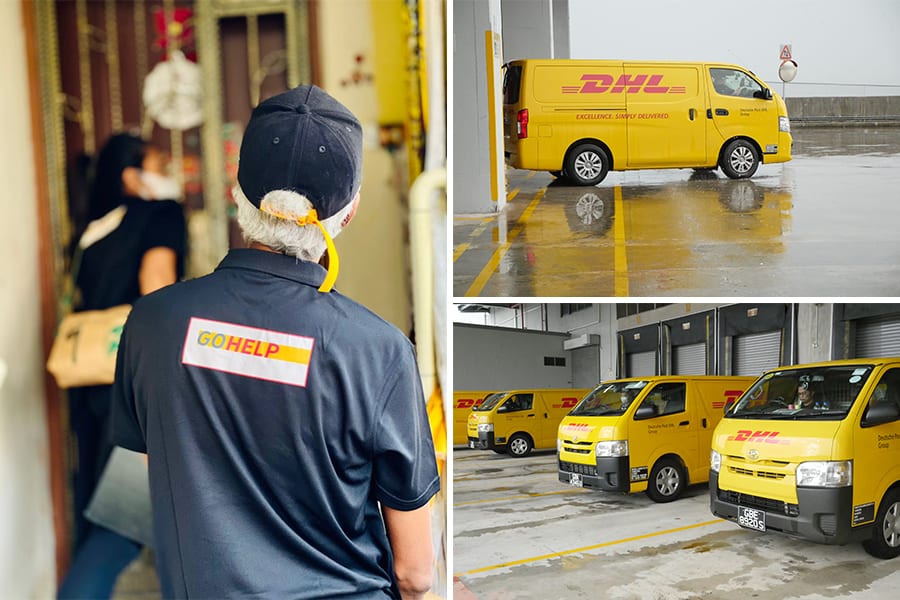
“We sought out our local Red Cross chapter, which had plans to donate essential items to needy and elderly beneficiaries who were isolated during Covid-19 lockdowns,” said Chen. The maiden project involved helping to pack and distribute boxes filled with essential grocery items such as dry and canned foods, household cleaning items, and medical products like adult diapers and lancets for those with diabetes.
It was a Group-wide effort: DHL Global Forwarding provided warehouse space, while staff from DHL Supply Chain, DHL Express and DHL eCommerce Solutions offered up manpower, transport and route planning expertise. Every month, 12 vans and volunteer drivers helped to complete each distribution round.
In nearby Australia and Malaysia, DHL’s GoHelp volunteers teamed up with the Salvation Army and the Malaysian Red Crescent. Funds were raised over Christmas to care for some of Australia’s homeless population, while the Malaysian Red Crescent sought DHL’s expertise to clean up, stocktake and automate approximately two tons of warehouse inventory consisting of food and emergency supplies.

“Localizing our GoHelp efforts has its advantages. We have supported and empowered NGOs with transferrable knowledge we hope can help in their future initiatives,” said Schelfhaut. “Furthermore, such projects don’t require the same scale of operational skills that disaster response often demands, so our cross-functional volunteers have all been able to help greatly in one way or another.”
The new normal of disaster response: stronger local teams, decentralized capabilities
Still, natural disasters continue to wreak havoc, and being unable to extend their usual support frustrated Schelfhaut, Chen, and their network of DRT volunteers. In 2020, flash floods and earthquakes affected large swathes of Indonesia and one of the world’s strongest-ever tropical cyclones hit the Philippines in November, taking dozens of lives and forcing over 150,000 victims from badly damaged residential areas.
In the wake of Super Typhoon Goni (or locally coined Rolly) which hit the hardest in the Catanduanes and Albay provinces of the Philippines, local GoHelp volunteers responded to assist the Philippines’ Office of Civil Defense (OCD) and AHA Centre with relief operations
Over a weekend, three of DHL’s disaster response volunteers in the Philippines worked alongside national responders to move 154 tons of relief goods and emergency supplies like shelter. The aid cargo was transported by land and sea from the AHA Centre’s emergency stockpile at the Disaster Emergency Logistics System for ASEAN (DELSA) Satellite Warehouse in Quezon City to the affected Bicol region and Marinduque Province.

“We need to keep this going not for ourselves, not for marketing purposes, but because I think that DPDHL is in the ideal position to give back to society in this way,” urged Schelfhaut. “Covid-19 will not prevent aid from traveling from point A to point B, even if international players may not be able to fly in to provide additional manpower.”
As a result, Schelfhaut said, countries are setting up their own capabilities and know-how to reduce their dependence on international help. “We have been moving fast to set up local teams in countries where they are lacking and gain support from local management to deploy employee volunteers where needed — this will be a lot of our focus in the coming year and as long as restrictions persist.”
The seasoned program lead concluded: “As long as I can help it, GoHelp will only continue to grow, adapting and learning from the challenges we have faced this past year.”
tags : DHL News,Humanitarian,DHL